I have an incredible friend, a new friend really, though I've known her since we were both smart and generally winsome high school classmates in Appleton, Wisconsin. Today, we are still both smart and generally winsome, I think it's fairly safe and true to say, and we are lucky enough to have rediscovered each other, which I think will almost certainly be a help in getting through the second half-century of life both of us statistically have before us. My friend has indisputably done far more with her innate intelligence than I have; I'm a petty civil servant, and she's a nationally renown neuropathologist. If I dwelt on that statement, I might feel gloomy, so I shan't. Instead, I'd like to talk about what my great new/old friend is doing.
She is doing her best to save brains. You may have seen articles about her work, because it's gained a lot of media attention over the last two years. In fact, a few days ago, she e-mailed me to tell me she'd just finished meeting with the former Surgeon General and the Commissioner of Football, wondering why, given this undeniable achievement, she still felt like the Hometown Girl from Appleton. Yes, she's the one, pretty much the Original One, who's started everyone talking about what's happening to all those professional football players who disappear from the playing field, who get dropped from everyone's roster, after suffering a few too many concussions.
What's happening? Well, they're suffering. Their brains are damaged. You can read about it in the archives of Time and the New Yorker and the New York Times or see my friend interviewed on any one of several network news magazines; the story's been everywhere. It's a sad, sad story, well-told by my friend and dismayingly well-documented. As a result of her ground-breaking work, you can bet there will be changes in the world of professional football and, if we're really lucky, within the world of amateur and youth athletics, too. It had to start with the stars, I guess, because the stars are the ones who command media attention. But eventually, maybe our children will benefit; eventually, maybe we will even stop encouraging our soft-skulled children to play games that simulate violence.
I remember when my son was in grade school. He, along with all his miniscule, adorable friends in the privileged environment of a wealthy little town in the foothills of the Colorado Rockies, had been "playing" soccer and "competing" in gymnastics ever since they were all extra-miniscule, super-adorable toddlers. By "playing," I mean standing out in the middle of the soccer fields holding hands with beautiful Rachel, engaged in earnest conversation until an errant black and white ball came flying down the lawn and rolled into the oblivious duo. They looked at each other in wide-eyed wonder and then exulted, loudly enough for all the adoring adults on the sidelines of the abbreviated field to overhear, "We hit the ball!!!"
But in third grade things got serious. They, the boys at least, were deemed big enough and tough enough for YMCA football. Well, Ben wasn't; his nickname at the time was "Stick," due largely to his uncanny resemblance to a toothpick with a wide-mouthed grin pinned lopsidely on top. But his male classmates were, some of them, and soon there was a retinue of 40-pound wonders outfitted in all the regalia of the all-American game. Soon afterward, the mom of one of the new pigskin passers confided to me over regulation coffee, "Susan, I don't think I really like the football deal. The coaches yell at the boys. They shout at them and make them feel bad."
Turns out that wasn't the worst of it.Turns out the yelling is actually the least of what's wrong with having 8 year old boys tackling each other on the hard ground of a Colorado playground. Turns out those big, ugly helmets don't provide adequate protection for the brains we need to read the contracts we're signing and the exemption clauses in our Income Continuation stipulations and our health insurance policies. Turns out nobody really gave this much thought, until my friend the neurologist who loves football and the men who play it came along. She is pretty much their guardian angel it turns out, not just their biggest fan.
Thank you, my friend. Now if only the rest of us would do our part. Like telling our children to jump rope instead of playing football. Really, it's the least and the best we can do.
Wednesday, May 5


Thursday, October 29
Talkin' 'Bout My Generation

This week, my old friend Glenn Silber came back to town to premiere a brand new documentary, Labor Day, a film of last fall's Obama campaign as seen by the members of the SEIU labor union members. But before we sat down in the Barrymore Theatre to see what we wrought in the great year 2008, we got to indulge ourselves with a look backward at what we did forty years ago here, with a 30th year anniversary screening of Glenn's first major documentary, the Oscar nominated War At Home.
I almost didn't go. A few weeks ago, during the Wisconsin Book Festival, I went to hear the very mini-panel of Bernadine Dohrn and her husband Bill Ayers ostensibly addressing the subject of their newly published book, Race Course Against White Supremacy. Believe me, it wasn't the "catchy" title that lured me in; it was simply idle curiousity, combined with simple idleness on a pleasant evening in October. That event made me feel so uncomfortable with my generation that I wasn't sure I could suffer a second gathering of gray headed liberals. There's just something in me that gets indisputably fidgety when a large lecture hall in an elegant arts center is full of old white people nodding their heads in unison in a discussion about racism. My generation has not only become hyperopic in middle age, we are way too often dismayingly myopic. It is not a good combination if you seek to see anything at all clearly.
But the night of the film showing was a beautiful night, so I clamped a light on my handlebars and set off for the theater. Two hours later, with a fresh copy of the DVD tucked into my bag, I pedalled home. My mind was full. My spirit felt as fresh as a child's. To be spinning my pedals with one pants leg rolled up and my hair bunched in a messy ponytail only made me feel more joyful and young and full of a sense of potential.
To watch The War At Home again was to remember not only that I was some teeny little part of a genuine change in consciousness forty years ago but to realize that my participation in it was both smaller and more important than I ever before realized. I came into this movement late, right before we pulled our troops out of Southeast Asia. The events on the Madison campus that Glenn documented in his first major movie all happened before I came to live here, most of them before I was even in high school, some of them while I was still a scrawny, buck-toothed blonde girl in braids, going door to door in Appleton, Wisconsin handing out literature endorsing Barry Goldwater at my dad's behest. I became involved in the anti-war protests just in time to learn how tear gas burned, just in time to experience the fright and, yes, the thrill of being chased down dark streets on the first wet nights of fall, hiding behind bushes and hoping the lights of the squad cars and riot vans wouldn't find you.
I got to know all of this. It changed my life and my generation uneradicably and radically. And now we are, most of us who shared this experience, old and gray and slow; our bellies sling over our beltlines just a little; our beltlines are a little too high to ever be fashionable again. We are old, and the battle scene has changed to Afghanistan and Iraq and Pakistan. Despite the little group of stalwart souls who stand mutely on street corners in college towns like Madison and Boulder once a week, dressed in black and holding up signs of steady antiwar protest, the movement is over. Wars are now religious rather than political, and we are slow and scared and uncertain, about almost everything except what we did as students at the tail end of the sixties. And I am jubilant riding my bike home tonight because finally I know who I am, finally I know what I believe.
Thirty/forty years ago, my peers and I were justified to protest. What we did was great, and we changed the world at an accelerated rate not usual to the course of history. But I didn't really know what I was doing. I was reacting. Looking for something, really anything, to replace the ruling tenets of my parents' lives. I'd lost my Christianity, and I needed something to believe in, some community that willingly enfolded me just as I was. The movement, and particularly its men, gladly embraced all comers, particularly perhaps young blondes who had successfully endured orthidonture.
What I didn't yet know was that beliefs could be rational and heartfelt and deep. I had been raised as a fundamentalist Protestant and fundamental to this is acceptance without questioning, without knowledge or proof. I made pretty much the perfect follower. But thirty years of life has a way of altering us. I am no longer such a good follower. In fact, I've been accused of being ornery, recalcitrant, and even snobby. I feel strong and calm about my values; they feel as much my own as my shadow, but more substantive.
And I can ride my bike in the middle of the night singing songs without worrying about what anyone will think of me, post blogs without caring how the world regards me. This is who I am. The movement of which I was a small part is a large part of me but not all of me. How nice to live long enough to feel this way.
I am a pacifist. I want everyone to get to live long enough and well enough to get to feel this way. And I ain't gonna study war no more.
Sunday, October 25
We Are the Walrus

As fall lurches in its irregular, irrevocable paces toward its grim successor, Sister Winter, I am spending doleful moments every morning staring bleakly at the contents of my drawers and closet. There are not enough warm clothes in the world to keep me warm through the coming season, I'm afraid. I wear so many clothes through the winter that those I meet during the next few months are invariably surprised in the summer when I finally reveal my real corporeal contours some. "Oh!" I've heard so many times it seems just a part of greeting summer, "I had no idea you were so slim!" In winter, I resemble those huge seals and sea lions lounging around under the long wharf in Santa Cruz harbor.
Not so most of the young women on campus, though. Where I have been dismayed all during these last warm months at the veritable acreage of naked female flesh that confronts me in every classroom and every stroll across the summer resort we call the UW, where I have occasionally found myself experiencing just the teeniest appreciation for Muslim women who don the burka, now finally one would hope that falling temperatures and increasing rainfall would compell something that might pass for modesty. Or at least prudence.
And yes, the short skirts that barely cover the buttocks are, by and large, gone, replaced by longish tunics that are stretched tightly over plump derrieres. The plunging necklines are, to my relief, now often camoflauged by scarves draped with attractive looseness but real functionality. Legs are almost routinely covered, in many cases by leggings that seem just a little tighter than the wearer's own skin. Jeans, too, are worn with something beyond simple snugness, with crammed-in flesh literally exploding where the low-rise "waistband" ends. I find myself looking with relief at the slobbiest girls, those who sluff around campus wearing sweatpants that drag through the wet leaves and suggest they have probably been slept in for at least several days.
Apparently, I've become a prude. Perhaps I always was, though I can remember (vaguely) several swimsuits that would indicate otherwise. I don't know exactly when this condition surfaced, but I suspect it was about the time youthful "fashions" began showing me first the younger generation's underwear, then eventually cracks and cleavages from all parts of their bodies that I really didn't want to confront at every street corner and right across my desk. Or perhaps this is a generational inevitability, given that my peers and I spent our own youth wearing washed out workshirts and flannels and jean jackets so shapeless that my own grandfather once looked in genuine puzzlement at my mom and asked in helpless confusion, "Isn't she a girl?"
I have nobly resisted, so far, the urge to yank up slouching pants and the more wicked companion impulse to yank them down. I have not scolded a single young woman for exposing breasts with as much nonchalance as I let show my crow's feet or the bags under my tired, old eyes. I have reminded myself innumerable times that every generation has its own way of irritating its elders. I have even tried to justify it intellectually, to persuade myself that there's a legitimacy to the argument which no one but myself has ever posed to me that we should not be distracted or distressed by our flesh; that like certain tribes in equatorial Africa, nakedness should not be construed as any kind of sexual intention.
But I have failed. Nakedness in the northern Midwest in our first world society is sexual. And more than that, it is overwhelming. It is overwhelming, in part, simply because we have so much more flesh than people in equatorial Africa; we are fat and we are crammed into clothing that is too small for us, and it is not that we cannot afford larger clothing, it's that we (and of course I use this plural rather figuratively here) have persuaded ourselves that this is fashionable. Yet I haven't seen a single ad promoting fatness and low cut clothing on the runway reveals nothing but ladders of rib bones.
Is it the fact that most of us can't be this skinny that resigns us to being fat? Breast size across the world is getting larger, even once we discount the fact that manufacturers of brassieres are changing their definitions of bra size to make women think they are larger than before. Girls are maturing a lot earlier and it seems that the accretion of body fat that begins at puberty now keeps increasing all the way through the child-bearing years. Is it our diet? Is it the hormones in our beef? Is it some sort of evolutionary advantage? Will women float better when global climate change forces us all back into the water of the sea? Are we heading toward becoming walruses and sea lionesses?
I am. Because I'm bundling up for winter and going shopping for more long sleeved thermals and turtlenecks and thick-knit sweaters, plus some socks that are so heavy I'll have to buy new shoes one full size larger. I'm the egg woman; I'm the walrus.
Saturday, October 24
The Fall Lure of Memory

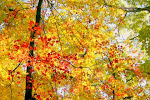
This picture was taken a little less than a week ago. It was such a clear, sunny day that I took off from work and drove away from the city just to walk through the woods in the hills on a weekday, when the only other people in the big state park were a few elderly couples picnicking on the shore of the lake. Once I went further than 100 feet from the main parking lots, there was no one; the elderly have to content themselves with sights set close to their cars.
And so I walked through the woods. This may seem unworthy of note, unless you know how unwoodsly a person I am. Squirrels terrorize me. The thought of a bear out bumbling for berries is enough to freeze me in my tracks even at midsummer. Bear scat. Is that bear scat? Does a bear scat in the woods and to what jazzman's staccato rhythm? Even a scampering bunny can make me turn in another direction. "Oops. Excuse me. Sorry. Didn't know this path was taken." But on this gorgeous day, I was determined to remain undaunted, a feeling only periodically undermined when a leaf would flutter earthward, just out of the alert line of my ever-vigilant vision. You may find this hard to believe, but the sound of one leaf falling to the earth can actually seem as loud as an elephant's footfall to the heightened senses of the leary.
Fall. I suppose if you lived in some unfortunate place that had no preponderance of deciduous trees, "autumn" would suffice to name this season. "Fall," it's interesting to note, is not commonly used for the season anywhere but North America. Here in the Midwest, it's the only word that fits. Here, the falling leaves rule. The best childhoods have memories that combine the parental ritual of raking very vaguely in the background of gleefully jumping in the resultant leaf piles. Forty, fifty, sixty years later, the smell of leaves in the sunshine brings back a memory of leisure and play that not even the now assumed chore of raking can render weary. I know. I just came in from raking.
But now, as a grown-up, despite those delicious memories of carefree times and happiness, I know what fall truly is. It is the last dance. It is the end of playtime. It is the last chorus of birdsong, the last splurge of color; not even sunrise and sunset will dress as bravely come the cold of fast-approaching winter. Pallor is just around the corner; my own skin already has less tint. Last night the big tree in front of my house, the one with the fairy house tucked between its protruding roots, that tree in one night shed almost every single one of its leaves. I know. I just raked them.
Raked them carefully into as high a pile as I possibly could in the little square of ground that passes for my front yard, being careful to pull out any sticks that came with the fallen leaves, making sure no animal waste was raked into it...just in case some passing child has need of leaping into some random pile of irresistibly colored fall leaves.
Friday, October 16
Motherless Children Childrenless Mothers

My friend Peter's mom died. She died of some horrid, messy cancer, not one of the ways anyone would ever select if given their choice of ways to leave earth, but still: At least the horrid, messy ways have a rather unsettling way of making death somehow seem a little less sinister, sometimes almost like someone you don't mind having show up at your table. And Peter got the news in a rather spectacular fashion, standing atop the highest vantage point on an island in the Pacific Northwest with the treetops and ocean below and the clouds all around, and the signal on his cell phone finally just strong enough to retrieve the message that was waiting for him from his sister: "Mom's gone." If you have to retrieve this sort of message, this may be the ideal place to be.
So you snap shut the cell phone and slip it back into your pocket. Now is not the moment to return the call. That call will be made soon enough. The urgency is gone. There is no more time question, no more waiting for the call. The clouds are caressing your calves like a cat who wants stroking. You clear your throat and it sounds softened by the moisture in the air. What remains to be said. You clear it again, though you have not a single word to say. Your mom's gone. Everything that will be said has been said. The words float away like wispy clouds, like smoke from a distant campfire, down in the canopy of trees. What remains unsaid once I love yous are done, once I'm sorry has been whispered. The ocean stretches out and seems without end. What is a horizon but a line. What is a line but an imaginary construct. A line goes to infinity, by definition. How far does a life go? Definitions are such fabrications and so comforting. What is a cloud. What's a mother.
Peter's mom died and my own is dying, too, and she called me last night soon after I had the news from Peter. I didn't tell her. I just told her I loved her, told her I missed her. Didn't tell her I was sorry for anything. One has to save something for the future. Here's a poem for all those moms, dying, because cruelly enough I still have words.
Mom, Dying
Doesn't there come a
day when the sunrise
is not sufficient, when
the trailed whistle of
some faraway train holds
no whisper of places
unseen, a day when you
will loosen the grip
of your boney fingers on
my pulse and just slip
into the night I have
pooled at your feet
with my ink? Do you
love me enough to
leave me lonely?
Wednesday, October 14
The Stormy Half of the Sky
I've been distracted by books lately. First, the Wisconsin Book Festival, with its full slate of panels and poetry and pop prose stars, a long delicious weekend culminating with Wendell Berry pouring his wise words like real maple syrup over everything: this Sunday evening festival finale a sold-out house of some 2,000 devoted followers of one of the truest gentlemen remaining. Then, once the syrup was licked from the fingers and work resumed on a Monday void of both fiction and sunshine, the return to the book begun earlier last week, Nick Kristof's Half the Sky.
I am having trouble reading this book, even though it's written in true journalistic style: short sentences, short chapters, vocabulary fit for an middle schooler. I'm having trouble reading this book even though it's got tons of material that's interesting to me, women and Africa and Islam and public service, enough to justify running to my favorite indie bookstore here in town to snatch up a hardcover copy at $27.95 on the day of its release. Half the Sky is an accounting of the lives of women in the developing nations of the world, accounts of what women face in terms of an everyday epidemic of rape and mutilation and outright murder, of women left to die outside village walls, in the corridors of hospitals, in the deafening silence of their friends, families and the worldwide community.
I now know, if somewhat vaguely, what a fistula is. It is not a curiously interesting word to learn, not like "biltrum" or even "blastula." I derive no pleasure from adding it to my vocabulary. It is an ugly word for a dreadful condition most commonly and most horribly associated with the most violent instances of gang rape, the all too frequent travelling companion of genocide and ethnocentric or religious violence. "Religious violence." Huh. Now there's a pairing for you, a set of words I wish I could say was an oxymoron.
The cover of this book promises that it's about turning oppression into opportunity. Periodically, as I close the book on another gruesome, depressing chapter, I find myself staring at that subtitle as if to evoke life from it. So far it's not working. So far all these stories of horrible events befalling women in distant parts of the world, even when valiantly addressed by other women from cultures near and far, are all so truly terrible that I find myself fearing for us, so much more than I fear terrorism or conservatism or chemicals in my food or even hunger...for when a mother can place her daughter outside for the hyenas to eat, when she can stand by as her daughter's genitalia are sliced off without anesthesia or reason, when boy soldiers can report that raping girls of nine is their due...well, yes, I wonder who we are and really what the heck we are doing here thinking we're fit to rule birds and lions and mosquitoes, let alone nations.
Saturday, September 26
The Hunger Within and Without
Suddenly, everyone's talking about food, and here in Madison, Michael Pollan can draw so big a crowd that cops are called out to direct traffic around the basketball/hockey arena where he's speaking on the subject of nutrition. Yes, you heard correctly: Mobs are gathering to learn about food.
Well, Pollan's actually speaking sort of against nutrition, a sort of pro-food, anti-nutrition position that begins to make sense once you read his bestselling books or listen to him. I preferred listening. I have tried reading two of his best-selling books, first The Botany of Desire then The Omnivore's Dilemma, and I have to confess I not only didn't finish them; I barely made it to page 30 of either. I have no problem with his analysis or his writing; he's a good writer making good points about issues we should attend...I guess I just don't want to read about food.
There's a book, allegedly for children, written several decades ago by one of my favorite authors, an incredible woman named Margaret Wise Brown. Her middle name is no accident, I'm quite sure. And the book of hers that comes most often to my mind is neither of her best known books, the children's classic Goodnight Moon or its marketed companion, The Runaway Bunny. No. The book I love is called The Important Book.
This slim book brings representative components of life down to their truest significance, to their very essence. I don't know any other book that does it as well, or even dares to try, and that includes the writings of Socrates and Sartre and maybe Richard Gibbard, along with the whole crew of writers of the various gospels. It doesn't really go head to head with Darwin or Einstein, essence being immune to either mutation or relativity. It doesn't address food really, other than the apple, but if it did, I am quite sure what it would say, and it would be this: "The important thing about food is it ends hunger."
Pollan and everyone else writing about good, truly nutritious food and the sustainability of our food supply are all right. We could eat a lot better than we do, most of us, by far most of us. And yet we are hungry and so we eat what is in front of us. We eat Froot Loops, and we put yogurt in plastic tubes in our children's lunches, and we are reasonably certain that the carrots we put alongside the silly plastic tubes of fruity, sugared yogurt are tossed, still in their unrecyclable Ziploc bag into the lunchroom garbage. We stop at McDonald's now and then, although we have begun checking our rearview mirror to see if anyone we know is within sight of our dereliction. Because we are hungry, and we are hungry for more than nutrition, even for more than flavor.
We are hungry to have life be easier. We are hungry to be able to believe that it's going to somehow turn out all right, to believe that McDonald's has not been poisoning us all these years or our children, raised on Happy Meals. I ruefully remember taking my children along with my best friend and her children to McDonald's when the children were small and we were obliging. Tracy and her children were devoted vegetarians. They ordered cheeseburgers, hold the burger. Their Happy Meals were soft, white, perfectly round buns with a single 1/8" slice of American cheese on it. And we were all so happy to be there.
We are hungry not just for health and correctness. We are hungry for time, hence the Happy Meals. Hungry for trust, to believe that our farmers are shipping us the same food they will serve at the table to their children. Hungry for a world that does not poison us. We are hungry for life to be simpler, to come home after a long, exhausting day of work and not have to cook a potful of dried legumes for six hours, not have to skin tomatoes and seed peppers before we can stew them into a pasta sauce. So we reach for a jar of Prego; we pop open a vacuum-sealed container of lentil soup. And when we go to bed with every intention of reading at least one chapter in one of the three books we currently have going, the one we put aside is Pollan's...but at least we bought it.
In Indonesia, during Ramadan, the servants of the middle class and wealthy tend to leave their house of employment to return to their homes in the villages of their birth. The employers of these nearly unpaid domestic laborers are forced to cook their own food and put their own children to bed. It is so exhausting a good percentage of them simply pack up and go stay in Jakarta's hotels for the duration of the Muslim holiday. Which I mention so you know it's not just we spoiled Americans who have difficult doing the right thing.
Cooking good nutritious meals is expensive and time-consuming. Unfortunately for the planet, lots of us have neither time nor money.
Subscribe to:
Posts (Atom)






 Posts

