Saturday, March 19

Living on Paul's Time

Don't wait. Time is indifferent to how it passes, how it fills. It would as soon be full of sorrows as joy, pain as pleasure, boredom as thrills, Netflix television as Schindlers List, Trump as Sanders. Do now what you need to do, if that is scour your toilet or quit your job or call youtr father. Ask the questions to which you need answers or at least need perspectives that will help you to your own answer. Did you mean to hurt me? Is Facebook connecting us or dividing us? Have I done all I can to save the planet for our children; have you?

When is the time right? When the rain stops? When I have reached the age of safe retirement? When the travel restrictions to a country are removed and trade begins? When I reach voting age, drinking age, car rental age; what age is the age that death may come? Paul died yesterday. He was my age. He was my friend. He was one of those wonderful people that slip into the world practically unnoticed and make it better. He not only had a constant stream of ideas, he pursued all of them. A few days before he died, he returned from Tasmania. Tasmania. What the heck was he doing in Tasmania?? Well, having beers with the locals, that's for sure. And probably hiking and camping and looking for any navigable current of water he could float. I'm really glad he didn't die in Tasmania. But that is the only polite thing I have to say about losing him.

I want Paul back. I wanted to beg him out to Wisconsin this summer, so I could show him my new town, ride its bike paths, talk about urban planning and land use ideas, drink beers in the sunshine and walk home with me singing and Paul laughing, because we both grew up in conservative Lutheran homes where everyone sang off-key and no one ever cared as long as you showed up in the pew every Sunday, spit spot clean and shiny.

After I heard the news about Paul I went and stood in a hot shower for about a half hour, crying. I live alone, so it's kind of feels silly walking around the house sobbing to no one; the shower allows for solo sobbing almost as well as it allows for solo singing. Then I pulled out a bunch of old photo albums from the shelf in the study, craving a picture of Paul. But we didn't take pictures back then, when I lived in the same small town that now will hold Paul's lifetime forever in its history. It wasn't the time it is now, when every meal and every evening with friends is touted on Facebook and Instagram so the rest of us are conscious of everything we didn't enjoy last night. But Paul would never have bothered to write any of this; he just wouldn't care. He wouldn't have seen what you had for dinner last night or what play I went to see and what I thought of it; Paul would have been simply enjoying his one wild and precious life, live and in person, strumming his banjo, talking with friends, finishing up a landscape blueprint on his computer before someone else walked in the front door of his ramshackle old house that of course he had designed himself but never finished and certainly never cleaned. Paul lived every day, every minute.

So don't wait. The right moment is whenever you can. I mean, you can't take that trip if you don't have a passport or you can't afford the ticket or your dog needs you. You can't win a race if you don't train or paint a picture if you don't have paints. But life can be short. Life can, in a wink, be done. I am never going to see Paul again. Despite our shared upbringing as Lutherans, neither of us is going to walk around in the clouds singing and laughing again.

I haven't posted anything in this blog in years. I may not post again for years. I don't know. I don't care. I had to write. And now I have to go and see if I can change the flights I was going to take this week to some that will get me instead back to Durango. 'Cause the time is now, always now, and that's where I need to be, now.

Saturday, May 7

Mother's Day 2011

A lot of my friends this weekend seem particularly intent on demonstrating to everyone within cyberspace that they are brighter and better than the rest of us. Yep. They're all waving the flag of political right-onness. Mother's Day was started by a trio of women who were more interested in celebrating women's commitment to peace than their ability to appreciate flowers. Still, one might note, a flower was chosen as the symbol of this: a red carnation.

I value peace and justice. I value mothers. And though I can't actually verify this and don't actually care to even try, I do suspect it's true that those of us who know what it's like to raise a child, to value another life more than you do your own, are those who know better than anyone else the yearning for peace in the world. Few mothers, after all, outlast their children. Those who do feel no joy in this.

But I am so tired of the people I know who seem to think they are better than those outside our little intellectual circles on the political and artistic left. I was raised by people, well-meaning people, who were convinced they were better than almost everyone else in the world, and I'm done with that as much as I can be.

Send me flowers, take me to brunch, feed me chocolates, or plant gardens with me. There is no way you might propose to commemorate Mother's Day with me that I would not find wonderful and full of meaning. You don't have to make it politically right. Just smile at me and say you love me.

Tuesday, June 8

Five Minutes of Rain Ranting

It's been raining without end. Things are feeling grim. The girls next door are actually beginning to tire of going outside under charming umbrellas after school; water rushing down the curbside gutters has begun to lose its appeal. I have not heard that needlessly optimistic line, "Well, at least we don't have to water the garden" for at least two days now. The dehumidifier in my basement is humming like the Fourth Tenor, all day and all night, minus the tuxedo. Last night it woke me up twice, just clearing its throat, apparently.

Me, I need sunshine. My whole being seems to shrink into a shell in a siege of dreariness like this. I don't care about getting wet. I just care about color and in order to have color you need to have light.How many shades of green can there be? Swarms of mosquitoes are rubbing their larval hands in glee at the prospect of blood ahead. The fish are not biting. The lakes are all roiled and muddy, and it's not really safe to go out in a boat. Great bloated bodies of preternaturally large carp loll near the shoreline of the beach behind my house.

This is not April. This is June. I attended a sermon on detachment this Sunday, but it's not helping me to let go of the deep seated disdain I feel for anyone who says with an inappropriate sense of brightness, "If you don't like the weather here, just wait five minutes." These are people who have never lived elsewhere. The weather here is as stolid as the denizens. It has been raining for days. Things do not change here. Winter is cold and too long. Summer is humid, almost to the hour. Rain hangs on for days. Fall is perfect sometimes.

Anyone who has lived here for more than 20 years should go somewhere far away. That means beyond Illinois or Iowa, Michigan or Minnesota.. At least once. And don't eat at any chain restaurants when you go, including the restaurant inside the Holiday Inn, even if they are serving prime rib as their special, maybe particularly if they're serving prime rib. Go. Go now.
Wednesday, May 5

Protecting Brains That Matter

I have an incredible friend, a new friend really, though I've known her since we were both smart and generally winsome high school classmates in Appleton, Wisconsin. Today, we are still both smart and generally winsome, I think it's fairly safe and true to say, and we are lucky enough to have rediscovered each other, which I think will almost certainly be a help in getting through the second half-century of life both of us statistically have before us. My friend has indisputably done far more with her innate intelligence than I have; I'm a petty civil servant, and she's a nationally renown neuropathologist. If I dwelt on that statement, I might feel gloomy, so I shan't. Instead, I'd like to talk about what my great new/old friend is doing.

She is doing her best to save brains. You may have seen articles about her work, because it's gained a lot of media attention over the last two years. In fact, a few days ago, she e-mailed me to tell me she'd just finished meeting with the former Surgeon General and the Commissioner of Football, wondering why, given this undeniable achievement, she still felt like the Hometown Girl from Appleton. Yes, she's the one, pretty much the Original One, who's started everyone talking about what's happening to all those professional football players who disappear from the playing field, who get dropped from everyone's roster, after suffering a few too many concussions.

What's happening? Well, they're suffering. Their brains are damaged. You can read about it in the archives of Time and the New Yorker and the New York Times or see my friend interviewed on any one of several network news magazines; the story's been everywhere. It's a sad, sad story, well-told by my friend and dismayingly well-documented. As a result of her ground-breaking work, you can bet there will be changes in the world of professional football and, if we're really lucky, within the world of amateur and youth athletics, too. It had to start with the stars, I guess, because the stars are the ones who command media attention. But eventually, maybe our children will benefit; eventually, maybe we will even stop encouraging our soft-skulled children to play games that simulate violence.

I remember when my son was in grade school. He, along with all his miniscule, adorable friends in the privileged environment of a wealthy little town in the foothills of the Colorado Rockies, had been "playing" soccer and "competing" in gymnastics ever since they were all extra-miniscule, super-adorable toddlers. By "playing," I mean standing out in the middle of the soccer fields holding hands with beautiful Rachel, engaged in earnest conversation until an errant black and white ball came flying down the lawn and rolled into the oblivious duo. They looked at each other in wide-eyed wonder and then exulted, loudly enough for all the adoring adults on the sidelines of the abbreviated field to overhear, "We hit the ball!!!"

But in third grade things got serious. They, the boys at least, were deemed big enough and tough enough for YMCA football. Well, Ben wasn't; his nickname at the time was "Stick," due largely to his uncanny resemblance to a toothpick with a wide-mouthed grin pinned lopsidely on top. But his male classmates were, some of them, and soon there was a retinue of 40-pound wonders outfitted in all the regalia of the all-American game. Soon afterward, the mom of one of the new pigskin passers confided to me over regulation coffee, "Susan, I don't think I really like the football deal. The coaches yell at the boys. They shout at them and make them feel bad."

Turns out that wasn't the worst of it.Turns out the yelling is actually the least of what's wrong with having 8 year old boys tackling each other on the hard ground of a Colorado playground. Turns out those big, ugly helmets don't provide adequate protection for the brains we need to read the contracts we're signing and the exemption clauses in our Income Continuation stipulations and our health insurance policies. Turns out nobody really gave this much thought, until my friend the neurologist who loves football and the men who play it came along. She is pretty much their guardian angel it turns out, not just their biggest fan.

Thank you, my friend. Now if only the rest of us would do our part. Like telling our children to jump rope instead of playing football. Really, it's the least and the best we can do.

Thursday, October 29

Talkin' 'Bout My Generation


This week, my old friend Glenn Silber came back to town to premiere a brand new documentary, Labor Day, a film of last fall's Obama campaign as seen by the members of the SEIU labor union members. But before we sat down in the Barrymore Theatre to see what we wrought in the great year 2008, we got to indulge ourselves with a look backward at what we did forty years ago here, with a 30th year anniversary screening of Glenn's first major documentary, the Oscar nominated War At Home.

I almost didn't go. A few weeks ago, during the Wisconsin Book Festival, I went to hear the very mini-panel of Bernadine Dohrn and her husband Bill Ayers ostensibly addressing the subject of their newly published book, Race Course Against White Supremacy. Believe me, it wasn't the "catchy" title that lured me in; it was simply idle curiousity, combined with simple idleness on a pleasant evening in October. That event made me feel so uncomfortable with my generation that I wasn't sure I could suffer a second gathering of gray headed liberals. There's just something in me that gets indisputably fidgety when a large lecture hall in an elegant arts center is full of old white people nodding their heads in unison in a discussion about racism. My generation has not only become hyperopic in middle age, we are way too often dismayingly myopic. It is not a good combination if you seek to see anything at all clearly.

But the night of the film showing was a beautiful night, so I clamped a light on my handlebars and set off for the theater. Two hours later, with a fresh copy of the DVD tucked into my bag, I pedalled home. My mind was full. My spirit felt as fresh as a child's. To be spinning my pedals with one pants leg rolled up and my hair bunched in a messy ponytail only made me feel more joyful and young and full of a sense of potential.

To watch The War At Home again was to remember not only that I was some teeny little part of a genuine change in consciousness forty years ago but to realize that my participation in it was both smaller and more important than I ever before realized. I came into this movement late, right before we pulled our troops out of Southeast Asia. The events on the Madison campus that Glenn documented in his first major movie all happened before I came to live here, most of them before I was even in high school, some of them while I was still a scrawny, buck-toothed blonde girl in braids, going door to door in Appleton, Wisconsin handing out literature endorsing Barry Goldwater at my dad's behest. I became involved in the anti-war protests just in time to learn how tear gas burned, just in time to experience the fright and, yes, the thrill of being chased down dark streets on the first wet nights of fall, hiding behind bushes and hoping the lights of the squad cars and riot vans wouldn't find you.

I got to know all of this. It changed my life and my generation uneradicably and radically. And now we are, most of us who shared this experience, old and gray and slow; our bellies sling over our beltlines just a little; our beltlines are a little too high to ever be fashionable again. We are old, and the battle scene has changed to Afghanistan and Iraq and Pakistan. Despite the little group of stalwart souls who stand mutely on street corners in college towns like Madison and Boulder once a week, dressed in black and holding up signs of steady antiwar protest, the movement is over. Wars are now religious rather than political, and we are slow and scared and uncertain, about almost everything except what we did as students at the tail end of the sixties. And I am jubilant riding my bike home tonight because finally I know who I am, finally I know what I believe.

Thirty/forty years ago, my peers and I were justified to protest. What we did was great, and we changed the world at an accelerated rate not usual to the course of history. But I didn't really know what I was doing. I was reacting. Looking for something, really anything, to replace the ruling tenets of my parents' lives. I'd lost my Christianity, and I needed something to believe in, some community that willingly enfolded me just as I was. The movement, and particularly its men, gladly embraced all comers, particularly perhaps young blondes who had successfully endured orthidonture.

What I didn't yet know was that beliefs could be rational and heartfelt and deep. I had been raised as a fundamentalist Protestant and fundamental to this is acceptance without questioning, without knowledge or proof. I made pretty much the perfect follower. But thirty years of life has a way of altering us. I am no longer such a good follower. In fact, I've been accused of being ornery, recalcitrant, and even snobby. I feel strong and calm about my values; they feel as much my own as my shadow, but more substantive.

And I can ride my bike in the middle of the night singing songs without worrying about what anyone will think of me, post blogs without caring how the world regards me. This is who I am. The movement of which I was a small part is a large part of me but not all of me. How nice to live long enough to feel this way.

I am a pacifist. I want everyone to get to live long enough and well enough to get to feel this way. And I ain't gonna study war no more.

Sunday, October 25

We Are the Walrus


As fall lurches in its irregular, irrevocable paces toward its grim successor, Sister Winter, I am spending doleful moments every morning staring bleakly at the contents of my drawers and closet. There are not enough warm clothes in the world to keep me warm through the coming season, I'm afraid. I wear so many clothes through the winter that those I meet during the next few months are invariably surprised in the summer when I finally reveal my real corporeal contours some. "Oh!" I've heard so many times it seems just a part of greeting summer, "I had no idea you were so slim!" In winter, I resemble those huge seals and sea lions lounging around under the long wharf in Santa Cruz harbor.

Not so most of the young women on campus, though. Where I have been dismayed all during these last warm months at the veritable acreage of naked female flesh that confronts me in every classroom and every stroll across the summer resort we call the UW, where I have occasionally found myself experiencing just the teeniest appreciation for Muslim women who don the burka, now finally one would hope that falling temperatures and increasing rainfall would compell something that might pass for modesty. Or at least prudence.

And yes, the short skirts that barely cover the buttocks are, by and large, gone, replaced by longish tunics that are stretched tightly over plump derrieres. The plunging necklines are, to my relief, now often camoflauged by scarves draped with attractive looseness but real functionality. Legs are almost routinely covered, in many cases by leggings that seem just a little tighter than the wearer's own skin. Jeans, too, are worn with something beyond simple snugness, with crammed-in flesh literally exploding where the low-rise "waistband" ends. I find myself looking with relief at the slobbiest girls, those who sluff around campus wearing sweatpants that drag through the wet leaves and suggest they have probably been slept in for at least several days.

Apparently, I've become a prude. Perhaps I always was, though I can remember (vaguely) several swimsuits that would indicate otherwise. I don't know exactly when this condition surfaced, but I suspect it was about the time youthful "fashions" began showing me first the younger generation's underwear, then eventually cracks and cleavages from all parts of their bodies that I really didn't want to confront at every street corner and right across my desk. Or perhaps this is a generational inevitability, given that my peers and I spent our own youth wearing washed out workshirts and flannels and jean jackets so shapeless that my own grandfather once looked in genuine puzzlement at my mom and asked in helpless confusion, "Isn't she a girl?"

I have nobly resisted, so far, the urge to yank up slouching pants and the more wicked companion impulse to yank them down. I have not scolded a single young woman for exposing breasts with as much nonchalance as I let show my crow's feet or the bags under my tired, old eyes. I have reminded myself innumerable times that every generation has its own way of irritating its elders. I have even tried to justify it intellectually, to persuade myself that there's a legitimacy to the argument which no one but myself has ever posed to me that we should not be distracted or distressed by our flesh; that like certain tribes in equatorial Africa, nakedness should not be construed as any kind of sexual intention.

But I have failed. Nakedness in the northern Midwest in our first world society is sexual. And more than that, it is overwhelming. It is overwhelming, in part, simply because we have so much more flesh than people in equatorial Africa; we are fat and we are crammed into clothing that is too small for us, and it is not that we cannot afford larger clothing, it's that we (and of course I use this plural rather figuratively here) have persuaded ourselves that this is fashionable. Yet I haven't seen a single ad promoting fatness and low cut clothing on the runway reveals nothing but ladders of rib bones.

Is it the fact that most of us can't be this skinny that resigns us to being fat? Breast size across the world is getting larger, even once we discount the fact that manufacturers of brassieres are changing their definitions of bra size to make women think they are larger than before. Girls are maturing a lot earlier and it seems that the accretion of body fat that begins at puberty now keeps increasing all the way through the child-bearing years. Is it our diet? Is it the hormones in our beef? Is it some sort of evolutionary advantage? Will women float better when global climate change forces us all back into the water of the sea? Are we heading toward becoming walruses and sea lionesses?

I am. Because I'm bundling up for winter and going shopping for more long sleeved thermals and turtlenecks and thick-knit sweaters, plus some socks that are so heavy I'll have to buy new shoes one full size larger. I'm the egg woman; I'm the walrus.

Saturday, October 24

The Fall Lure of Memory


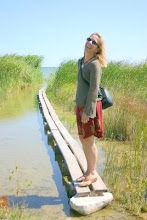
This picture was taken a little less than a week ago. It was such a clear, sunny day that I took off from work and drove away from the city just to walk through the woods in the hills on a weekday, when the only other people in the big state park were a few elderly couples picnicking on the shore of the lake. Once I went further than 100 feet from the main parking lots, there was no one; the elderly have to content themselves with sights set close to their cars.

And so I walked through the woods. This may seem unworthy of note, unless you know how unwoodsly a person I am. Squirrels terrorize me. The thought of a bear out bumbling for berries is enough to freeze me in my tracks even at midsummer. Bear scat. Is that bear scat? Does a bear scat in the woods and to what jazzman's staccato rhythm? Even a scampering bunny can make me turn in another direction. "Oops. Excuse me. Sorry. Didn't know this path was taken." But on this gorgeous day, I was determined to remain undaunted, a feeling only periodically undermined when a leaf would flutter earthward, just out of the alert line of my ever-vigilant vision. You may find this hard to believe, but the sound of one leaf falling to the earth can actually seem as loud as an elephant's footfall to the heightened senses of the leary.

Fall. I suppose if you lived in some unfortunate place that had no preponderance of deciduous trees, "autumn" would suffice to name this season. "Fall," it's interesting to note, is not commonly used for the season anywhere but North America. Here in the Midwest, it's the only word that fits. Here, the falling leaves rule. The best childhoods have memories that combine the parental ritual of raking very vaguely in the background of gleefully jumping in the resultant leaf piles. Forty, fifty, sixty years later, the smell of leaves in the sunshine brings back a memory of leisure and play that not even the now assumed chore of raking can render weary. I know. I just came in from raking.

But now, as a grown-up, despite those delicious memories of carefree times and happiness, I know what fall truly is. It is the last dance. It is the end of playtime. It is the last chorus of birdsong, the last splurge of color; not even sunrise and sunset will dress as bravely come the cold of fast-approaching winter. Pallor is just around the corner; my own skin already has less tint. Last night the big tree in front of my house, the one with the fairy house tucked between its protruding roots, that tree in one night shed almost every single one of its leaves. I know. I just raked them.

Raked them carefully into as high a pile as I possibly could in the little square of ground that passes for my front yard, being careful to pull out any sticks that came with the fallen leaves, making sure no animal waste was raked into it...just in case some passing child has need of leaping into some random pile of irresistibly colored fall leaves.

Friday, October 16

Motherless Children Childrenless Mothers


My friend Peter's mom died. She died of some horrid, messy cancer, not one of the ways anyone would ever select if given their choice of ways to leave earth, but still: At least the horrid, messy ways have a rather unsettling way of making death somehow seem a little less sinister, sometimes almost like someone you don't mind having show up at your table. And Peter got the news in a rather spectacular fashion, standing atop the highest vantage point on an island in the Pacific Northwest with the treetops and ocean below and the clouds all around, and the signal on his cell phone finally just strong enough to retrieve the message that was waiting for him from his sister: "Mom's gone." If you have to retrieve this sort of message, this may be the ideal place to be.

So you snap shut the cell phone and slip it back into your pocket. Now is not the moment to return the call. That call will be made soon enough. The urgency is gone. There is no more time question, no more waiting for the call. The clouds are caressing your calves like a cat who wants stroking. You clear your throat and it sounds softened by the moisture in the air. What remains to be said. You clear it again, though you have not a single word to say. Your mom's gone. Everything that will be said has been said. The words float away like wispy clouds, like smoke from a distant campfire, down in the canopy of trees. What remains unsaid once I love yous are done, once I'm sorry has been whispered. The ocean stretches out and seems without end. What is a horizon but a line. What is a line but an imaginary construct. A line goes to infinity, by definition. How far does a life go? Definitions are such fabrications and so comforting. What is a cloud. What's a mother.

Peter's mom died and my own is dying, too, and she called me last night soon after I had the news from Peter. I didn't tell her. I just told her I loved her, told her I missed her. Didn't tell her I was sorry for anything. One has to save something for the future. Here's a poem for all those moms, dying, because cruelly enough I still have words.

Mom, Dying
Doesn't there come a
day when the sunrise
is not sufficient, when
the trailed whistle of
some faraway train holds
no whisper of places
unseen, a day when you
will loosen the grip
of your boney fingers on
my pulse and just slip
into the night I have
pooled at your feet
with my ink? Do you
love me enough to
leave me lonely?

Wednesday, October 14

The Stormy Half of the Sky

I've been distracted by books lately. First, the Wisconsin Book Festival, with its full slate of panels and poetry and pop prose stars, a long delicious weekend culminating with Wendell Berry pouring his wise words like real maple syrup over everything: this Sunday evening festival finale a sold-out house of some 2,000 devoted followers of one of the truest gentlemen remaining. Then, once the syrup was licked from the fingers and work resumed on a Monday void of both fiction and sunshine, the return to the book begun earlier last week, Nick Kristof's Half the Sky.

I am having trouble reading this book, even though it's written in true journalistic style: short sentences, short chapters, vocabulary fit for an middle schooler. I'm having trouble reading this book even though it's got tons of material that's interesting to me, women and Africa and Islam and public service, enough to justify running to my favorite indie bookstore here in town to snatch up a hardcover copy at $27.95 on the day of its release. Half the Sky is an accounting of the lives of women in the developing nations of the world, accounts of what women face in terms of an everyday epidemic of rape and mutilation and outright murder, of women left to die outside village walls, in the corridors of hospitals, in the deafening silence of their friends, families and the worldwide community.

I now know, if somewhat vaguely, what a fistula is. It is not a curiously interesting word to learn, not like "biltrum" or even "blastula." I derive no pleasure from adding it to my vocabulary. It is an ugly word for a dreadful condition most commonly and most horribly associated with the most violent instances of gang rape, the all too frequent travelling companion of genocide and ethnocentric or religious violence. "Religious violence." Huh. Now there's a pairing for you, a set of words I wish I could say was an oxymoron.

The cover of this book promises that it's about turning oppression into opportunity. Periodically, as I close the book on another gruesome, depressing chapter, I find myself staring at that subtitle as if to evoke life from it. So far it's not working. So far all these stories of horrible events befalling women in distant parts of the world, even when valiantly addressed by other women from cultures near and far, are all so truly terrible that I find myself fearing for us, so much more than I fear terrorism or conservatism or chemicals in my food or even hunger...for when a mother can place her daughter outside for the hyenas to eat, when she can stand by as her daughter's genitalia are sliced off without anesthesia or reason, when boy soldiers can report that raping girls of nine is their due...well, yes, I wonder who we are and really what the heck we are doing here thinking we're fit to rule birds and lions and mosquitoes, let alone nations.

Saturday, September 26

The Hunger Within and Without

Suddenly, everyone's talking about food, and here in Madison, Michael Pollan can draw so big a crowd that cops are called out to direct traffic around the basketball/hockey arena where he's speaking on the subject of nutrition. Yes, you heard correctly: Mobs are gathering to learn about food.

Well, Pollan's actually speaking sort of against nutrition, a sort of pro-food, anti-nutrition position that begins to make sense once you read his bestselling books or listen to him. I preferred listening. I have tried reading two of his best-selling books, first The Botany of Desire then The Omnivore's Dilemma, and I have to confess I not only didn't finish them; I barely made it to page 30 of either. I have no problem with his analysis or his writing; he's a good writer making good points about issues we should attend...I guess I just don't want to read about food.

There's a book, allegedly for children, written several decades ago by one of my favorite authors, an incredible woman named Margaret Wise Brown. Her middle name is no accident, I'm quite sure. And the book of hers that comes most often to my mind is neither of her best known books, the children's classic Goodnight Moon or its marketed companion, The Runaway Bunny. No. The book I love is called The Important Book.

This slim book brings representative components of life down to their truest significance, to their very essence. I don't know any other book that does it as well, or even dares to try, and that includes the writings of Socrates and Sartre and maybe Richard Gibbard, along with the whole crew of writers of the various gospels. It doesn't really go head to head with Darwin or Einstein, essence being immune to either mutation or relativity. It doesn't address food really, other than the apple, but if it did, I am quite sure what it would say, and it would be this: "The important thing about food is it ends hunger."

Pollan and everyone else writing about good, truly nutritious food and the sustainability of our food supply are all right. We could eat a lot better than we do, most of us, by far most of us. And yet we are hungry and so we eat what is in front of us. We eat Froot Loops, and we put yogurt in plastic tubes in our children's lunches, and we are reasonably certain that the carrots we put alongside the silly plastic tubes of fruity, sugared yogurt are tossed, still in their unrecyclable Ziploc bag into the lunchroom garbage. We stop at McDonald's now and then, although we have begun checking our rearview mirror to see if anyone we know is within sight of our dereliction. Because we are hungry, and we are hungry for more than nutrition, even for more than flavor.

We are hungry to have life be easier. We are hungry to be able to believe that it's going to somehow turn out all right, to believe that McDonald's has not been poisoning us all these years or our children, raised on Happy Meals. I ruefully remember taking my children along with my best friend and her children to McDonald's when the children were small and we were obliging. Tracy and her children were devoted vegetarians. They ordered cheeseburgers, hold the burger. Their Happy Meals were soft, white, perfectly round buns with a single 1/8" slice of American cheese on it. And we were all so happy to be there.

We are hungry not just for health and correctness. We are hungry for time, hence the Happy Meals. Hungry for trust, to believe that our farmers are shipping us the same food they will serve at the table to their children. Hungry for a world that does not poison us. We are hungry for life to be simpler, to come home after a long, exhausting day of work and not have to cook a potful of dried legumes for six hours, not have to skin tomatoes and seed peppers before we can stew them into a pasta sauce. So we reach for a jar of Prego; we pop open a vacuum-sealed container of lentil soup. And when we go to bed with every intention of reading at least one chapter in one of the three books we currently have going, the one we put aside is Pollan's...but at least we bought it.

In Indonesia, during Ramadan, the servants of the middle class and wealthy tend to leave their house of employment to return to their homes in the villages of their birth. The employers of these nearly unpaid domestic laborers are forced to cook their own food and put their own children to bed. It is so exhausting a good percentage of them simply pack up and go stay in Jakarta's hotels for the duration of the Muslim holiday. Which I mention so you know it's not just we spoiled Americans who have difficult doing the right thing.

Cooking good nutritious meals is expensive and time-consuming. Unfortunately for the planet, lots of us have neither time nor money.

Friday, September 25

Diminishing the spaces between us

Today a wonderful young man named Enrique taught me how to greet the man I love when I meet him. I'll give you a hint. It did not involve a handshake. It did not involve a hearty hug either, no crushing anyone to the chest, no thudding anyone on the back. It involved a light touch of the hand to the hip, a light kiss to the cheek. Maybe two.

I'm not even romantically involved with Enrique, and I have to tell you it was wonderful. So, because it was so wonderful, I'm going to share it with you. I am hoping, you see, to start an inocuous and dumfounding epidemic of loveliness, a spate of undeserved contentment that has hitherto missed the Land of the Puritans and the Home of the Charlatans. I think this is just what our country needs right now. Because I'm serious: You could not greet anyone this way or be greeted this way and not feel somehow cherished. You might even get to remember what a blush feels like, a blush, which is itself a most wonderful phenomenon, a mixture of honor and humility expressed with that most human of paint: our rising blood. And to feel cherished is to feel content and to feel content is to quit picking on everyone around you. America needs this. I need this. My friends agree I need this.

So try this. Try it first with someone you already love or at least trust. Next time you see them, next time you spot him or her walking down the sidewalk grinning at you like a fool or dozing in a favorite reading chair with a mouth unattractively slung open or maybe waiting impatiently for you in the theatre lobby, pacing as curtain time ticks closer and closer---do this. Walk up slowly (rouse them if they're napping) but don't say anything, and when you are close enough to touch, reach out with your right hand and touch them lightly. If there is no romance between you, touch near the waist, just to connect your two persons. If you're romantically involved, touch more personally, maybe right at the vulnerable place where the curve of the hip bone melts into the hollow of the groin, don't press: just touch, not so anyone else can see, but just the two of you. And then you are close enough to lean over and kiss the left cheek once, lightly, don't dwell, just be gentle. If you feel continental, kiss left, then right. If you really love this now hushed friend of yours, kiss the left cheek twice. Don't rush it. This is a moment to savor.

Americans have a funny thing about space. We live in a country with more wide open space than nearly any other, and we are still fencing it in. We covet houses with acres of rolling green lawns and then we situate them in gated communities where no bare feet will ever feel their lushness. We not only keep more space between our houses than other cultures, we keep more space between our persons, whether we're friends or lovers or strangers. Our beds are bigger than most cultures' bedrooms. We keep each other at a distance. Distance is part of what is America. It has been part of what has accorded us power: the oceans that once separated us from Europe and Asia. We feel safe when we are isolated.

Oceans, however, don't really matter much anymore, and so here in North America we have somewhat awkwardly embraced hugging in the last five years or so. Hugging has become fashionable, almost de rigeur in certain circles, but it's so robust it's not even really personal. Handshakes are certainly not personal. But kissing, gentle kissing, this is personal. The curve of a waist or a hip is personal, whether you are stout or anorexic or obese or just plain old normal. Touch is personal.

Next time you meet a friend, someone you trust and love, don't hug, don't shake, don't slap on the back, reach out,touch them, kiss them. We could use an epidemic of intimacy. "And if you really like this person a lot," Coach Enrique tutors, with a knowing twinkle in his eyes, "you locate the kiss a little closer to the lips. The closer, the more you like. And if you kiss twice, you really like."

I really like the way they think south of the newly walled-in border.

Monday, September 21

The Happiness Ceiling is Falling

OK, I'll come right out and say it: I'm depressed. Perhaps some of this has been showing through in recent blog posts, or perhaps my gloominess regarding current events seems so well warranted that it didn't occur to you that it was personal at all. But it is. Depression, depressingly enough, is almost always personal, unless we are talking economics, which can also be, well, depressing.

But no. I am sufficiently depressed that I am actually going to find time to find a therapist besides you, my unseen, unknown reader. I want to talk to someone who will always have a box of tissues on the client side of her desktop, within easy reach. My mom and dad used to fulfill this function, my mom with a (clean) tightly folded sheet of Kleenex tucked reliably into the band of her shirt or dress sleeve, my dad always, always, ALWAYS with a perfectly ironed handkerchief folded squarely into his back trouser pocket.

My parents undoubtedly still have their respective hankies tucked into their everyday clothing. I won't ask them, though, and I'll be doing my best not to even let them know I could start crying at any given moment of time, that a flood of uncontrolled sobbing is only as distant as the next kind smile or the next knit brow of disapproval. Be unexpectedly nice to me or unexpectedly surly: Anything can start me crying right now. And a lot of it has to do with my parents, which is precisely why I'm at my most valiant and cheerful when I'm with them, why I won't be asking them for their hankies, I hope.

My mom is dying, bravely but terribly, from ALS. I see her almost every weekend, and her muscles and abilities are disappearing almost more quickly than I can record or absorb. My dad, who never ever expected to outlive the woman he fell in love with sixty years ago, is doing his best to take care of her, but at 84 years old and having never before done household tasks like cleaning and cooking or dressing another person, his skills are understandably limited, if expanding. I see them almost every weekend, and I do my level best to bring not only physical strength into their lives but also to bring them what may ultimately be more important: good cheer.

But I am running out of cheer, it seems, hence my need to spill my sadness to you, here, and also to the therapist I hope to find this week. And I find myself noticing articles like Maureen Dowd's column in this last Sunday's NYT, entitled "Blue Is the New Black," about increasing levels of unhappiness among those we might call "post-feminist women," referencing a culture-wide growth of unhappiness among women, posts like Ariana Huffington's, "The Sad, Shocking Truth About How Women Are Feeling."

What's the deal? Apparently, I'm not the only woman of my generation who is sensing a lowered ceiling to the sky. Apparently, the clouds have been gathering, while we were busy becoming mothers and executives, scholars and politicians, community leaders and volunteers. While we were busy raising our children, assessing their daycare, organizing their OM and DI groups and cheering their every soccer goal and homerun hit. While we were all worried about cracking our noggins on a glass ceiling. While we were so busy we never stopped to look down and inside ourselves and wonder who was taking care of us.

Men, it seems, have become happier. For the documentation of this, you can read Dowd's excellent column, referenced elsewhere, or Marcus Buckingham's book titled Find Your Strongest Life. And why would they not? They are no longer the sole breadwinners. We are helping pay for the kids' college; we are plunking our money into the retirement fund. And we are still doing the lioness's share of the housework, the childcare, the volunteer work, and the contact and maintenance of family ties with parents and with siblings. No wonder we women are becoming exhausted and live our present lives perpetually on the verge of tears.

It is the first full day of autumn. There is a new moon overhead in the sky, even if the cloud ceiling has lowered here in Madison today, and the glass ceiling remains a factor in our womanly endeavors. For me, it is time to get some help. For me, it's time to acknowledge that I am not the Superwoman I pretend to be around my dying, enfeebled parents or the effervescent free spirit and energetic creative intellect my friends and coworkers routinely expect me to be. I need some help, and I'm going to get some. I hope you will, too, if you recognize yourself in any of this.

For Dowd's column, see: http://www.nytimes.com/2009/09/20/opinion/20dowd.html

Friday, September 18

Walking to School Through the Land Mines

It began, I believe, with the Nike Foundation. "Invest in a girl and she will do the rest." The idea, to put it simply, is to spend a teeny bit of money enabling a girl from a underdeveloped nation to attend sufficient school that she attains literacy, then let her return to her familial duties and watch the improvements roll on in. This concept is based on the following observation: When women and girls earn income, they reinvest 90 percent of that income into their families; men reinvest only 30 to 40 percent.

Known now as "The Girl Effect," the amazing ripple effect of educating one single adolescent girl is now behind social and economic improvement movements in countries from China to Botswana and back up to Pakistan. Health, wealth and welfare all improve noticeably when girls are allowed to gain literacy. Population growth subsides. Infant and maternal mortality plummet. And if wars are society's cruel means of doing to men what childbirth does to women in areas without prenatal care and natal medical expertise, then perhaps we might even expect to see the grim statistics of war deaths slow somewhat, too.

Take a girl to school today. Give her a book and a notebook and a pencil. Better yet, give her an iMac notebook and a book and a good lunch. Give her a safe place to learn, a place where she can decide for herself whether or not she wants to wear a hijab. Leave the burkas at the door please; shoes are optional, except in wintry climates. The boys are either already at school or they're out in the fields learning to wield the heavy blade of a machete. Let the old men and women fix the lunches and watch the crops dry up in the fields for lack of rain. Send a girl to school today.

The Girl Effect is a very wonderful effect. Educated girls return to their families and communities and share their newfound knowledge. It spreads. Conditions improve. Other girls go to school and the ripples continue to spread. It's just about the best thing happening in un- and under-developed countries of the world today, especially if you take the time to stitch it loosely to some of the great work being done with mini-grants and cottage industries in parts of Africa, again, using women as economic producers. And yet you may have noticed a note of futility in my narrative voice today.

One, every time I think of this unknown adolescent girl heading off to school, I can't help but notice a shadowy shape leaning against the doorway of her home. It's a man, and there's a weapon slung over his shoulder or stuck in the waistband of his trousers. It's a soldier. And at some point he's going to rape our adolescent girl, right now heading off to school with a pocketful of hope and a little something to eat at lunchtime. And at some point he will kill someone and at some point some other soldier will kill him. Meanwhile, our slight girl, slight glimmer of hope, is walking lightly down the dusty road to school. If the Girl Effect is truly to take hold and spread, we need to get this man out of the doorway of her home, too. We need to stop the violence.

It seems a little unfair to leave the salvation of the world up to this slight figure in loose clothing heading down a faraway road with a song in her heart. Girls are great, no doubt about it, but it shouldn't be left up to them. The ripples of educating girls do spread over the pools of our interconnected lives. But in all this talk about the phenomenon of female motivation, I find another thought running like a river alongside this newer, stronger current, a babble I've been conscious of for as long as I can remember and then some, back into the rivers that flowed through my mother's veins and my grandmothers' and their mothers back in the Old Country: "A woman's work is never done..or appreciated...or paid for...or..."

It's time to take that weapon away from the man in the doorway. It's time to take away nuclear development options not only from North Korea and Iran, but from Russia and yes from ourselves. It's time to quit organizing men into armies as if they have nothing better to do. The women of this world wouldn't need their protection if they would only stop being soldiers. Then maybe a woman's work, a girl's effect, might be truly accomplished.

Thursday, September 17

A Gate at the Celestial Stairs, With Armed Sentinels

I just finished reading local author Lorrie Moore's newest novel, A Gate at the Stairs. It's an uneven novel that sometimes feels like a house that's had a few too many owners, a few too many additions, some of them well-made, others less so, even a few spaces that make you cringe some to enter. Happily, though, Gate.. finishes well, and you close the book with a feeling of satisfaction, tinged slightly with regret, as good books have a tendency to leave us. You also close the covers with a feeling of sadness, for it is not a joyful story and the culminating event of the narrative, the death of the narrator's teenaged brother in Afghanistan, is too close to our own moment to give us any scant comfort of distance. As I finished reading it, as the heroine was climbing into the coffin that held her younger brother's blown-apart remains, newspapers and blogs were full of the ongoing and reinvigorated debate over our military presence in that besieged nation.

Feelings on this run higher than usual in my family this round, as a very dear and special person who has been a part of our family circle just enlisted in the U.S. Army's Special Forces. The wind is knocked out of me by this; my heart feels bruised and tender. No one in my family has enlisted in any branch of any military since my father's stint as a Lieutenant in the Navy during WWII. My family in succeeding generations has changed. Most of us are no longer the kind of people who follow leaders very well. We're made up now of Democrats and Quakers and Unitarians, Jews and liberal Christians; our idea of military service is attending antiwar protests and prayer vigils, and we don't even do those very well. And now someone we know and love has voluntarily enlisted in a unit that is not only military but aggressively so, charged with often covert violent actions intended to protect US citizens, a secretive and undercover military organization which has as its very basis strict obediance regardless of violence, motive or intention.

It has stirred deep emotions, some of them rising in the middle of the night to stand like sabered sentinels at the gateway to sleep, forbidding entrance. It has made me wonder why he would do this, what attracted this bright and talented young man to years of unbreakable service in far away places doing untellable deeds at someone else's command? He is not a young man who needed to see the world; he is extremely well-read, well-travelled and even well-mannered. He is not a young man who needs income nor education nor career. He has everything our country, a loving and affluent family, and good genes can offer.

The Special Forces are what we used to call the Green Berets. I looked it up, and this is part of what Wikipedia offers: "The United States Army Special Forces, also known as Green Berets, is a Special Operations Force (SOF) of the United States Army tasked with five primary missions: unconventional warfare, foreign internal defense, special reconnaissance, direct action, and counter-terrorism....Currently, Special Forces units are deployed in Operation Iraqi Freedom. They are also deployed with other SOCOM elements as one of the primary American military forces in the ongoing War in Afghanistan. As a special operations unit, Special Forces are not necessarily under the command authority of the ground commanders in those countries. Instead, while in theater, SF operators may report directly to United States Central Command, USSOCOM, or other command authorities."

This is not an issue I will resolve in one blog posting. There is no single pill I can toss down my throat to feel better. I have been asking so many questions, among them biggees like, "Do I want to feel that I, as an American citizen, am protected?" "Do I think we should have a standing army, let alone Special Forces?" You see, of course if I want "someone" to enlist, then I have to be able to accept that someone I love may enlist, but I'm not really so sure I want anyone to enlist. I'm not so sure about sending soldiers anywhere. I don't really understand why we don't just send teachers or food or power generators or running shoes or more flu shots. I'm not so sure the "Girl Effect" isn't more important than spreading democracy or enforcing democracy. I'm not even sure it isn't contradictory to think about "enforcing democracy." I'm not so sure we, with Joe Wilson's behavior so prominent, should even be touting democracy this week.

There will be more on this. There are enough people blogging about Joe Wilson and racism and the Obama administration right now. Me, I am left with the lines from the first 45RPM single record my older sister bought: Sgt Barry Sadler's Ballad of the Green Berets. "Fighting soldiers, from the sky. Fearless men, who jump and die... He'll be a man, they'll test one day: Have him win the Green Beret."

And I'm also left with the question of whether we should be sending more troops to Afghanistan.

Sunday, September 13

The Real U.S. Open: Refereeing Congress

Serena Williams is being fined $10,000 for yelling at a referee at a sporting event. The referee had just made a verifiably wrong call about a foot fault on a serve done by Ms. Williams in her final round of competition at the U.S. Open today. In addition, she was fined another $500 for racket abuse. She may, pending the result of the ongoing investigation, have to forfeit her entire winnings from the tournament and/or be banned from all further Grand Slam tournaments. These are the consequences for losing control of language in the heat of an adrenaline-fueled competition, in a field of endeavor--professional athletics--that routinely includes benches emptying for brawls, slug-outs on the ice, and coaches being jettisoned from the playing field. Tennis, of course, is a more refined sport than ice hockey, right?

Congressman Joe Wilson, R-SC, meanwhile, who dissed the President of the United States of America during a joint session of Congress last week, breaking the most basic rule of comportment of those august chambers of democratic debate, may be asked to apologize again, to amplify the muttered apology he delivered to the President's aide last week to the full floor of the House of Representatives. Mr. Wilson was empassioned and therefore not able to control his lips or his tongue. Thank god he didn't have a hockey stick. Thank god doubly he didn't have a gun.

There will be no fine. There will be no payment. There may not even be a public apology or sincere acknowledgement of wrongdoing. There have been no real consequences. This, after all, is the Arena of Advanced Argument. I am the referee; you are the referee. We approve or we censure with our votes and our commentaries.

Does anyone besides me find it ironic and somehow dismaying that a tennis player is held to higher standards of accountability than those who serve in our Congress?

Friday, September 11

Nine one one nine eleven 911

Eight years it's been. Some of us have forgotten. Some of us lost no one when the towers came crashing down. Some of us lost friends, family, neighbors, enemies, innocence. Some of us lost careers, some only computers. Some of us lost our sense of safety. Only some of got it back since. Some of us were changed, changed utterly. Some of us shrugged it off, said "What'd ya think? That humans were good?" Some of us still believe humans are good. Some of us were changed utterly. Some of us still don't know what we lost; we're still wandering around in the ashes, scuffing our bare feet in the cold ashes of girders and mortar and gold fillings. Some of us said it was evil flying those planes through the clear September morning; some few of us said a prayer even for those souls that drove their own lives into the side of those tall tall towers, some very few.

Eight years and all is not well. No one's captured, no one's accountable, the world is not better off, airplane travel will never be anticipated eagerly by anyone over the age of six; eight years and we're still arguing about who we are looking for and in what country we are looking. Hide. Hide everything. Run stealthily.

Eight years and I am still full of unanswerable sadness and a sense of loss growing more profound with each passing day.

Thursday, September 10

Hooligans in the House: Rednecks Above the Starched Collars

What is wrong with Republicans? I mean, besides their politics...

Last night's behavior of those on the right side of the Congressional aisle catapulted us right back to where we were during the electoral campaigns last fall: dumfounded by the rudeness of those who claim to have a firm grasp on the American ideal.

Something happened, it seemed, when Republicans realized that they could not sustain a working majority just representing the rich. The percentage of those identifying with the rich had grown so uncomfortably small, you see, like the collar of a fat man, stiff and white and oh so tightly buttoned up, it was making the blood vessels threaten to burst on those Daddy Warbucks jowls. The Republicans needed to beef up their ranks. In fact of matter, they plain old needed a rank, a rank and file of Republicans.

So. Time to rip off that stiff white collar. Pull off that tie too. Southern rednecks would fill up the empty seats in the townhall meetings...good old plain Americans with good old reverence for the American greenback and a healthy disdain for that pesky and growing population that was filling the Democratic ranks so fluently: the wetbacks. No way Republicans were ever going to succeed in winning over significant numbers of the nation's rapidly growing Hispanic population, not with their stance on immigration. And the overwhelming preponderance of white faces in their ranks was doing little to convince African Americans that Republicans really represented their best interest.

And so they turned to the south, to the rancor of rednecks, which had never really healed from the Civil War and who still had enough good old American intolerance around to fill a spitoon to overflowing so why not a dying political party full of cranky old white men and a few well-coifed white women. Bring on the rednecks. Their values, after all, weren't really so far from those pasty old white men's, certainly not from Limbaugh's or O'Reilly's or anyone who spoke for the right from televised pulpits. The right had nodded at the idea of an uneducated, vindictive, and overtly misinformed and malicious Presidential candidate in Sarah Palin already; it was clear that neither intelligence or civility were assets valued by the Republican leadership any more.

And now the Republicans stand for bad manners and boorishness and outright incivility. I find it frightening. The importance of behaving with good manners is not about how many weeks you have to write a thank you note; it's about allowing discourse despite differences. You speak, I speak. We take turns. We don't shout each other out; we listen and respond with as much civility as we listen. And the halls of Congress, where our most important differences are addressed in order to form policy that effects each and every one of us, no matter what our opinion, ought to be the place where civility is best demonstrated.

Representative Joe Wilson's outburst during President Obama's address to the joint members of Congress last night was more than lamentable, it was pathetic and outrageous and worthy of censure from not only his peers in Congress both Democrats and Republicans, but from his constituents. South Carolinans, having barely weathered the scandalous behavior of a governor who can't keep his pants zipped, now stand represented by someone no more mature than a 9 year old heckler. He is unworthy of a seat in our Congress. A five year old interrupting a teacher with such an outburst would suffer consequences. There should be some firm consequences for Joe Wilson.

What have the Republicans proposed be done? Rush Limbaugh doesn't even think the rude man should have offered a token apology. Republicans are snickering in their antechambers, aiming at that old spitoon. They should be wondering just what kind of people they've invited to the party and what has become of their values. The politics of fear is now the politics of crude, rude belch-in-your-face-and- damned- if-I'll-apologize-for-anything. I'm starting to yearn for the days when Republicans just seemed snobby and rich and full of disdain for the rest of us.

Sunday, August 23

What if a plane crashed and nobody remembered it: would it still exist

Another week and another man let go while Aung San Suu Kyi is still imprisoned by the walls of her house, with another year and a half just added to the sentence that was about to expire when American John Yettaw decided to force himself upon her. John Yettaw has since been freed and allowed to return home to the US. This week's political release was someone found guilty of killing 288 people in 1988. Convicted by the Scottish judiciary system following the explosion and subsequent crash of Pan Am Flight 103 over Lockerbie, Scotland in 1988, Abdel Baset el-Megrahi was diagnosed in prison with prostate cancer. Now expected to live only months, he was released on so-called "compassionate grounds," allowed by Scottish law.

Nasty rumors are rampant. After the newly freed man was given a hero's welcome as he stepped off the plane in his home country of Libya, Libyan leaders loudly and profusely thanked the British government for freeing him, citing it as a welcome accomplishment of a oft-sought goal in trade negotiations between Libya and Britain. Britsh officials have, of course, roundly denied this preposterous idea. Whatever might possibly persuade any part of the waning British empire to consider freeing a man who their own judiciary found guilty of murdering hundreds of innocent civilians, most of them American?

Hmmm. Could it be that slimy old rascal who keeps appearing in all the trouble spots of the world, our old friend OIL? Why, as a matter of fact, Libya does just happen to have, as the British are wont to say in that lovely, melodic way they have of making English sound courtly still, "lots and lots and lots of" yessirree, oil. In fact, Prince Andrew was just preparing to leave on a special trade mission to Libya when all this unwelcome attention fell on the issues of Libyan/British relationships.

Compassion. I rather like compassion. I like it when kitties are rescued from trees, when traffic is held up by pedestrians to give an elderly woman more time to make a crossing, when a student who is genuinely ill is given a second chance to take a missed final examination. I don't mind it when prisoners are allowed to work away from prison or given conjugal visits in nice, private rooms or time to cuddle with their children. In many, many cases I wouldn't even mind it if an elderly prisoner was allowed to return home to die.

But not a mass murderer. Not someone whose disregard for life cost nearly three hundred people their lives and the thousands of people who loved those 288 people the long-lasting pain of sudden, unanticipated loss that leaves you hanging like a brown leaf from a burned out tree in the center of a battlefield. This is not compassion. This is disrespect. This is haunting, chilling, frightful disrespect.

And if it turns out in any way to be related to a favorable trade deal, may the spirits of those 288 dead haunt the British ministers into their own early graves.

Saturday, August 15

Making the World Safe for...Mormons?

It didn't take long. John Yettaw has been released from custody by the Myanmar regime. Apparently, even tyrants and jail guards are sick to death of listening to the unlikely story of Joseph White's rendez-vous with divinity and looking at John Yettaw's pathetically pale and flacid visage. He's on his way back to the good old USA. Aung San Suu Kyi, who did no wrong except to show compassion? She was let out on a leash for a meeting with American Senator Jim Webb, but now (whew! I felt so endangered for those 40 minutes!) she is back home and the world we live in is back to its usual complacent self. And just what will the delightful Mr. Yettaw be up to next? Will he try to rescue Daw Kyi a third time? I can hardly wait to see the movie.

I don't like to feel cynical, but this fills me with despair. Senator Webb should have offered a trade: The General gets to keep Mr. Yettaw; Aung San Suu Kyi gets sent home with Mr. Webb. Not that I'm sure she would go. Again, the wait for the movie. Maybe Gus Van Sant could do it?

Friday, August 14

Rescuing Innocents Abroad

If I had readers other than my faithful few friends today's entry would be risky. I would like to express a mean and nasty sentiment, which in all my readings of newspapers, magazines and online commentaries, I have not yet seen articulated by anyone: that perhaps the two reporters rescued from the jurisdiction of North Korea by Bill Clinton should have been left to their fate there.

I know. I feel as nasty as Sarah Palin right now, as slimy as Newt, as despicable as the meanie rabblerousers at recent town meetings on health care. I am not being kind and generous. I am not even acknowledging that the two reporters convicted by North Korea of espionage are women, delicate looking women, with husbands and a child at home. Would I feel differently if the two of them were thick necked and hirsute, with knotty muscled biceps and triceps? If they were Republicans? If they were French?

I guess I don't know, though I suspect not. I feel like these two reporters should have been very well aware of the risks of what they were doing, scouting around the borders of the Koreas digging up information unfavorable to the regime on the other side of the borderline. They were, after all, studying and writing about Koreans. Was there something about the border they forgot? Was there something about Kim Jong-il's face they thought suggested leniency or tenderness?

I feel the same way about these two reporters that I do about the Mormon missionary who swam across the lake to violate Aung San Suu Kyi. His family members are saying, "How could he have known?" He knew. The reporters knew. We should be rescuing the innocent, not those who knowingly violate borders. There are plenty of innocents incarcerated if we are looking for people to rescue.